


Art by Maurice James, Jr.
Freedom Over 250 Years
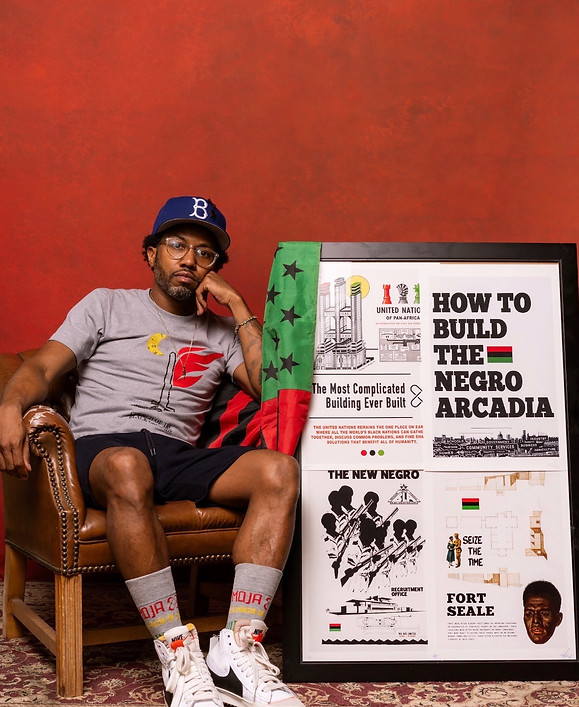
"I view my practice as "time travel". By casting Black Americans as victors, deities, and protagonists in historical propaganda and pop-culture moments, I am building a Black Utopia—a mental and visual space where fear and discrimination are replaced by beauty, power, and genius. This work is designed to affect both the conscious and subconscious, fostering a sense of "Black Confidence" that allows the observer to see themselves as they have always been: divine and central."
- Maurice James, Jr.
The art offered by Maurice James, Jr. reflects on the African American image. The perception of Black folks seems to always be in flux in America. Take a moment to ponder over the art and let us know what comes to mind.
Harriett Tubman
Harriet Tubman, one of America's most courageous freedom fighters. Reimagined through Maurice's contemporary artistic lens, the piece bridges past and present, reminding us that freedom is not merely a historical achievement but an ongoing pursuit. Tubman's legacy of resistance, self-determination, and collective liberation resonates deeply with the exhibit's central question: What does freedom mean to you today? Through bold imagery and cultural symbolism, Maurice James, Jr.'s work challenges viewers to reflect on the sacrifices that expanded freedom for others and to consider their own role in shaping a more just and equitable future. His contribution enriches The DAP Project by connecting personal reflection with the larger story of freedom's unfinished journey in America.
Frederick Douglass
Douglass's life journey—from enslavement to becoming a renowned abolitionist, author, statesman, and advocate for justice—embodies the transformative power of freedom and the courage required to claim it. Through Maurice James, Jr.'s distinctive artistic vision, Douglass is reintroduced to contemporary audiences not as a figure confined to history, but as a timeless symbol of intellectual independence, self-determination, and moral leadership. The artwork invites viewers to reflect on the freedoms won through sacrifice and struggle, while challenging us to consider how freedom is experienced, protected, and expanded in our own time. By placing Frederick Douglass at the center of this conversation, Maurice James, Jr. reminds us that freedom is both a personal responsibility and a collective pursuit—one that continues to shape our communities and our nation today. This work serves as a compelling bridge between past and present, enriching The DAP Project's exploration of what freedom means across generations and inspiring visitors to contribute their own voices to this ongoing dialogue.
Ida B. Wells
Through his powerful visual language, Maurice James, Jr. captures Wells not only as a historical figure, but as a continuing force in the conversation about truth, courage, and freedom. Ida B. Wells used the power of the pen to challenge oppression, expose injustice, and demand accountability at great personal risk. Her unwavering commitment to truth-telling remains deeply relevant in today’s ongoing pursuit of equity and human dignity. Featured at the Mariposa Museum in Oak Bluffs, this work invites viewers to reflect on the many dimensions of freedom: the freedom to speak, to seek truth, to resist injustice, and to advocate for others. By including Ida B. Wells in this exhibition, Maurice James, Jr. reminds us that freedom is sustained not only through landmark moments in history, but through the courage of individuals who refuse to remain silent. This artwork stands as both tribute and call to action—encouraging each visitor to consider how their own voice, values, and actions contribute to the meaning of freedom today.
Uncle Tom
Originally introduced in Harriet Beecher Stowe’s 1852 novel Uncle Tom’s Cabin, Uncle Tom was portrayed as a man of deep faith, moral conviction, and unwavering humanity in the face of enslavement. Over time, however, popular culture transformed the character into a symbol carrying meanings far removed from Stowe’s original depiction. Maurice James, Jr.’s artwork invites viewers to reconsider the complexities of this figure and to reflect on how history, memory, and representation shape our understanding of freedom. By placing Uncle Tom within the context of What Does Freedom Mean to You Today?, the artist encourages a deeper examination of identity, dignity, resistance, and the stories societies choose to preserve—or distort. The work challenges viewers to look beyond stereotypes and engage with the difficult questions surrounding race, perception, and the struggle for self-definition. Featured at the Mariposa Museum in Oak Bluffs, this piece serves as a catalyst for dialogue about the evolving meanings of freedom and the power of art to revisit history with fresh eyes. Through this work, Maurice James, Jr. reminds us that understanding the past is essential to shaping a more honest and liberated future.
Justice Thurgood Marshall
At the heart of this story is Marshall, the pioneering civil rights attorney who successfully argued Brown v. Board of Education before the U.S. Supreme Court, helping to dismantle the legal framework of school segregation. His legal victories paved the way for the Little Rock Nine—nine Black students who, in 1957, courageously integrated Central High School in Little Rock, Arkansas despite threats, harassment, and intense national opposition. Through his striking artistic vision, Maurice James, Jr. captures the intersection of legal advocacy and personal bravery that transformed the Civil Rights Movement. The artwork serves as a reminder that freedom is often advanced through both collective action and individual courage—through those willing to challenge injustice and those willing to walk through doors that others fought to open. Featured at the Mariposa Museum in Oak Bluffs, this piece invites visitors to reflect on the enduring relationship between education, opportunity, and freedom. It asks us to consider how access, equity, and the pursuit of justice continue to shape our understanding of what it means to be truly free.